












History Section July update
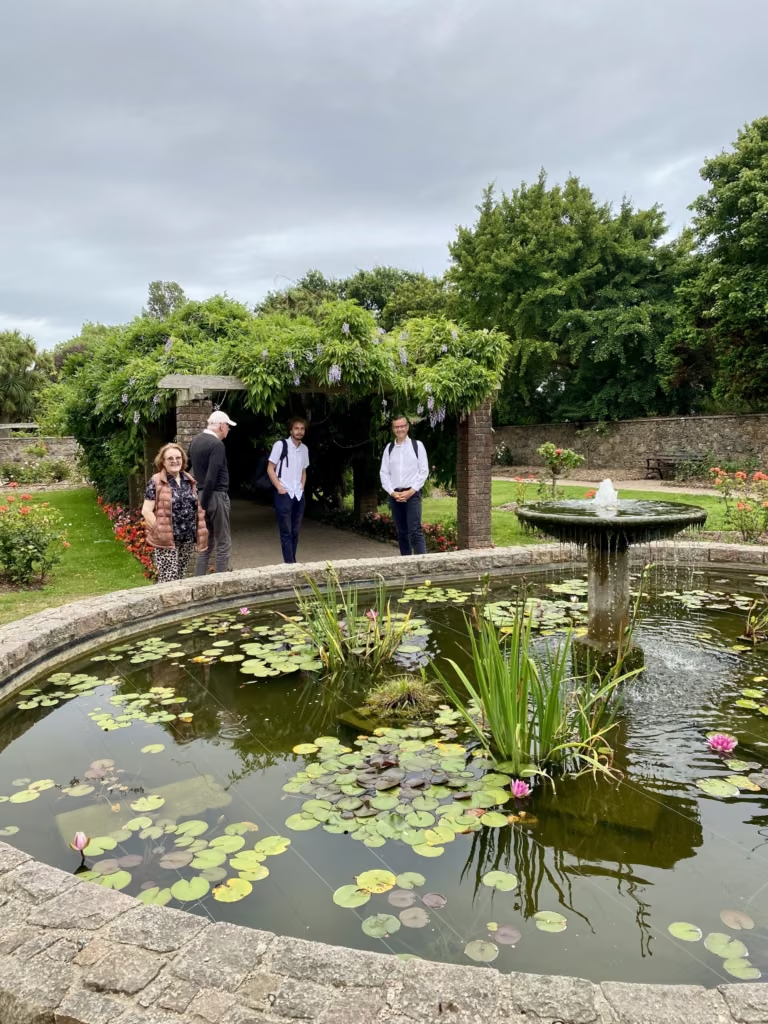
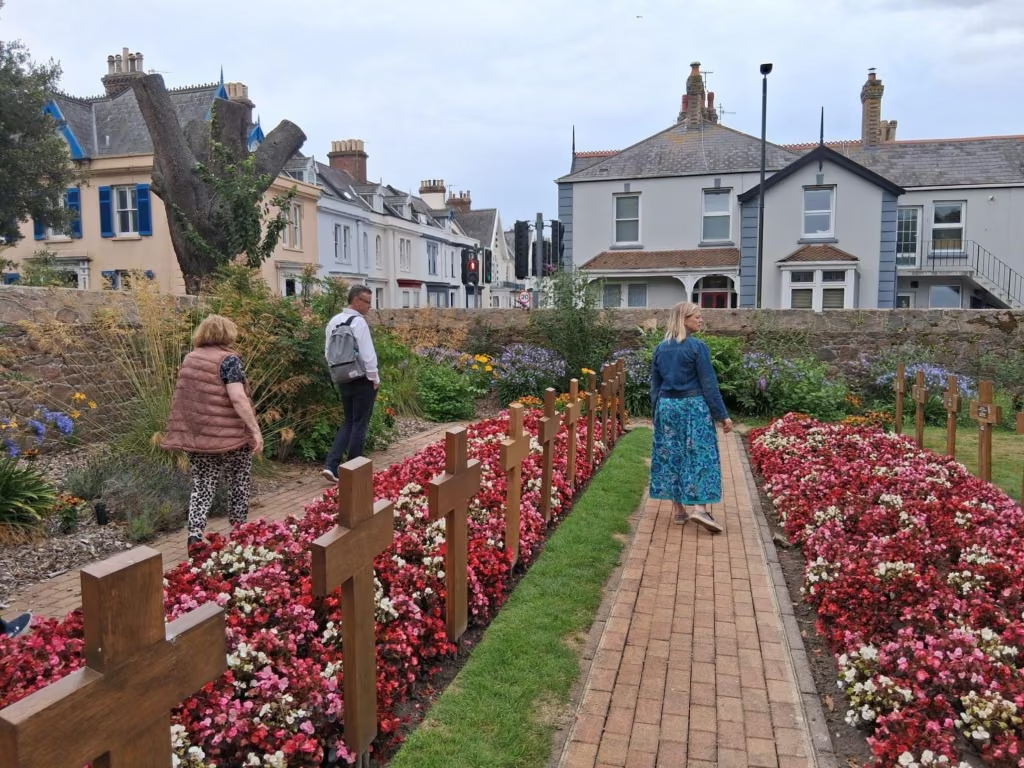
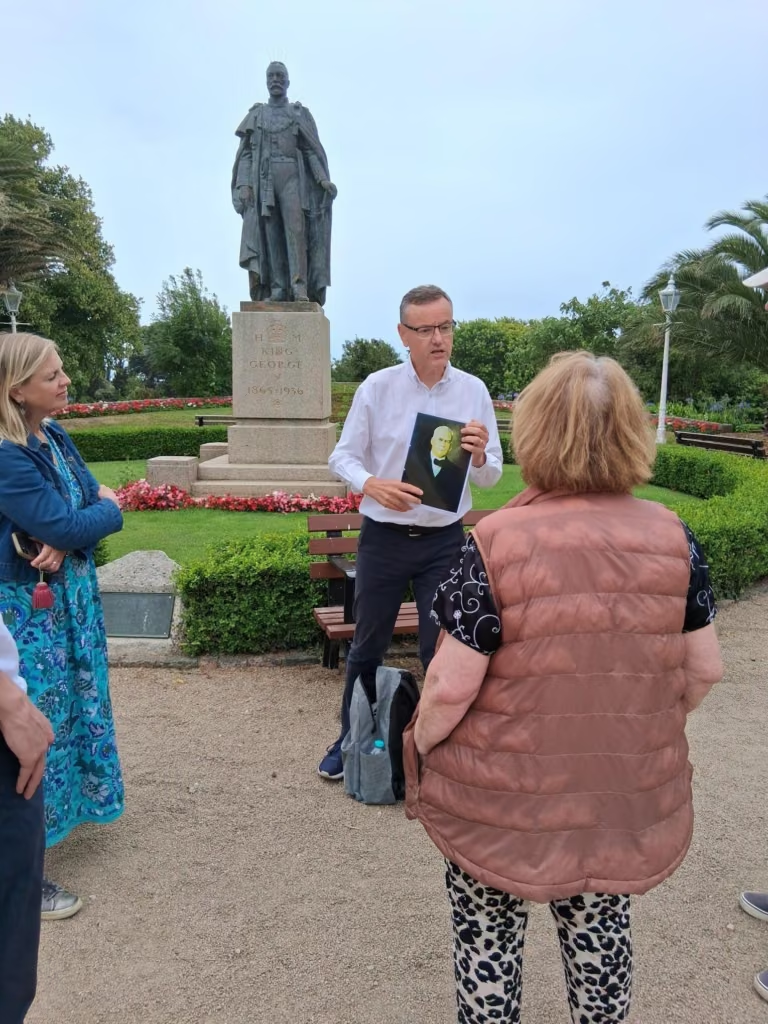
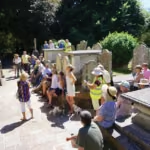
This month the Section went on a guided walk around Howard Davis Park courtesy of Ian Ronayne.
T. B. Davis will be a name familiar to most in Jersey thanks to his philanthropic deeds following the death of his son Howard during the Great War. Born to humble origins in Havre des Pas in 1867 Davis would go on to establish a successful stevedoring business in South Africa and became extremely wealthy. Following the death of his son, Davis bestowed a number of gifts upon the island.
The park as a memorial
As is common with public areas the park is home to several memorials, most prominently from the main gates being that of King George V. This statue was commissioned by Davis himself and stands in its current position in accordance with his wishes. As Ian explained, Davis was the owner of the yacht Westward and he frequently participated in races with the Royal Yacht Britannia. On the death of King George V in 1936 Davis retired the yacht from racing. At some time the boom from the Westward was displayed behind the statue of the late King, however this has been dismantled owing to its poor state of repair.
The next, and sadly until recently neglected memorial is perhaps the most important in the park, being that of Howard Davis. As part of the original gift to the island in 1939 it was stipulated by T. B. Davis that this memorial be maintained and open to the public. Members of the section were pleased to see that the hall was open and the painting of Howard Davis was in its proper position, thanks in a large part to one of our members, Sue Hardy. During the Great War like so many young men Howard Davis answered the call and joined the British Army. Whilst a man of his rank might have been considered for the officer class Davis instead opted to join as a common soldier. In 1916 he participated in the battle on the Somme where he sadly lost his life. Following this T. B. Davis embarked on his philanthropic ventures in a large part to memorialise his lost son. The tranquil landscaping of the park lies in stark contrast to the artillery churned mud of Great War battlefields, perhaps encapsulating the post-war optimism of a new and more peaceful world.
This however would not be the case since by the time the park had even opened on 30 September 1939, the Second World War was already in progress.
Our walk concluded at the military cemetery which is situated within the park grounds, opposite St. Luke’s Church. The cemetery was laid out in November 1943 by the German occupying forces and primarily holds the dead from HMS Charybdis which was lost in October of that year. Charybdis was a Dido class light cruiser and served successfully during the Mediterranean campaign before being reassigned to the Atlantic to hunt German blockade runners around the French Coast as part of a small task force including six destroyers.
On the night of the 22nd-23rd October 1943 however, Charybdis was sailing into a trap. Detected by German radar, several torpedo boats were despatched. Charybdis was caught unawares and sustained two torpedo hits, the destroyer HMS Limbourne also sustained a hit losing her bow. Charybdis was crippled and sunk, whilst Limbourne remained afloat but was scuttled when it became apparent that she could not be towed back to Britain. In all the Royal Navy sustained over 500 casualties, and over the next weeks and months the dead began washing up on beaches in the Channel Islands.
When walking along the neat lines of the cemetery the horrors of war become all too apparent, due to the time the men of the Charybdis spent in the sea there are many who are known only to God. Unusually their graves are marked with dark oak crosses, locally sourced from a donation by Lady Stewart who had lost her own son in the Great War.
This concluded our walk and gave new perspective on the park. The space serves as a poignant reminder to the dead of two world wars and we should be thankful as an island to T. B. Davis for donating this space to the public all those years ago.
Oliver Thébault, MA
Secretary – History Section
Section email – History@societe.je