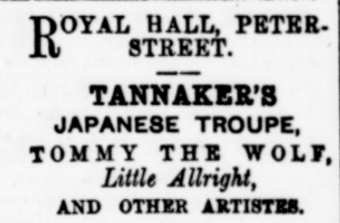
Our September meeting was initially billed as a night featuring a light hearted history of entertainment but instead it became one of mysteries, bigamy, and a world wide search for the truth, as Pernille Rudlin outlined her research into the enigmatic Tannaker Buhicrosan.
The story (possibly) begins in 1867 when Buhicrosan travelled to Japan, for centuries a closed country, but now recently opened to outside influence. There, he assembled the Royal Tycoon Troupe, a group of performers that fascinated audiences across Hong Kong, Calcutta and Australia. Pernille described the origins of the daikagura tradition, performances that were originally a holy dance before becoming recreational performances in addition to ladder tricks and contortions, all narrated in Tannaker’s own (suspiciously Liverpuglian) voice.

THE JERSEY CONNECTION
In August 1872, Tannaker and his troupe arrived in Jersey for a 12 night run at the Royal Hall in Peter Street. Audiences from local schools and orphanages joined the wider population to watch displays of traditional Japanese activities. Lest you think that this was a benevolent or a kindly act by Buhicrosan, Pernille confirmed that such performances featured child labour. Indeed, Buhicrosan had been fined for child cruelty, following the unfortunate death of a young member of his troupe in 1872. Pernille suspects that Buhicrosan’s motivations for visiting Jersey were more opaque. This perhaps included an attempt to track down his father, who was not Japanese at all. From the records, it appears this was William Bellingham Neville – a physician of spurious credentials and son of the John Bellingham the assassin of Spencer Perceval. She wondered perhaps whether Tannaker had come to seek out some inheritance.
To this end, she requested SJ’s expertise in answering the following:
If any theatre/entertainment specialist has any further insights onto the Royal Hall on Peter Street – was it on a regular circuit of performing troupes from Britain?
-Or was it rather unusual for a troupe like Tannaker’s to turn up?
-Any insights on why people came to Jersey from Britain in the 1850s – for a rest cure/health?
-To escape debtors or being sued in Britain?
-Or as one of your members said – there was a lot of immigration around that time for work – navvies etc. – which would have been an attractive audience for Tannaker’s troupe in the 1870s
Tannaker’s adventures in Jersey were short lived. Following his return to the UK, he put on several cultural events, culminating in Japanese village in Hyde Park. Following his bankruptcy in 1892, his family settled in Lewisham. Whilst there are still many mysteries about Tannaker Buhicrosan, Pernille’s research offers fresh insights to a previously obscure history.
By Lauren Jai
Member of History Section
The Section and all our members would like to thank Pernille for her fantastic talk and we wish her the best of luck with all her research.
If you have any further information relating to Tannaker Buhicrosan, his troupe, the Royal Hall in Peter Street, or any of the questions raised during the talk, the History Section would be delighted to hear from you. Your insights may help shed further light on this fascinating historical mystery. Please contact us at history@societe.je.